
A Synopsis of The Business Promoter

Cover Page

The Business Promoter: A Journey of Transformation in Microfinance

In the world of business, especially microfinance, challenges are inevitable. The Business Promoter chronicles the journey of a manager at Stellar Microfinance, navigating through difficult situations, financial setbacks, and leadership struggles. Faced with mounting loan defaults and declining morale, the manager seeks guidance from an old friend, Philip, a successful vice president at Global Microfinance.

Through insightful discussions and practical advice, Philip emphasizes the importance of understanding the needs of both employees and customers, creating a culture of commitment, and fostering teamwork. The narrative uncovers how a shift in mindset—focusing on customer service, employee well-being, and sustainable practices—can turn a struggling business into a thriving one. With powerful lessons on leadership, responsibility, and the value of innovation, this story demonstrates that true business success goes beyond profits, focusing on people and purpose.
Moving Ghana Forward: My Thoughts

A high percentage of Ghanaians, which includes me, have love for President Mahama. We voted for  him in the last polls, for President.
Remarkably, after calling five constituency chairmen in the Central and Western Regions to congratulate them for the hard work they put in to ensure a Mahama victory, each of them responded along very similar lines this way: “ Well, the glory belongs to GOD. What we pray for is for GOD to use Prez Mahama as a vessel to bring progress and “comfort” to ease the burden of all Ghanaians and raise the name of Ghana higher… But if President Mahama doesn’t deliver as we hope for, we will change the NDC too.”
We have come of age. Not only are such expressions of love for the country, seemingly above partisan politics, by grassroots stalwarts refreshing, but that is also what electoral politics is meant for: hope-testing for the best team. However, an even more hopeful proposition is the fact that the President himself only knows this too well. He emphasized this point in his election victory speech when he said, “The average Ghanaian has little or no tolerance for bad governance”.
And so amid the parliamentary hearing and confirmation and congratulatory messages to each of the President’s nominees, one can only hope that the appointees are cognizance of the trust imposed in them by the President and the expectations fellow citizens have of them: that it’s not about the position per se, but it’s about good performance.
But we have been here before. Since 1992, there have been a series of changes in governments and corresponding presidential appointments. Each new government came with hope and the general goodwill offered by the generality of Ghanaians; but in most cases, both the government and the performance of public officials have been lackluster. Each new administration tended to portray the outgone one as flawed, evil, and anti-state. Yet, we desire better.  The hope now, more than ever before, is that President Mahama can be trusted to deliver – better than anyone else in our country can. His campaign slogan, “Building the Ghana we Want Together” is a call suggestive to every one of us that “we are all involved” and Ghana belongs to all of us. Once again, Ghana belongs to all its people. Hence, “Susubiribi”.
Resetting” Ghana gives the subtle impression that we have veered off course for some time and need to retrace our steps to pick up from a certain past vision that worked previously, and through some fine tuning can work again. This means recalibrating the processes of statecraft to accept and implement best practices through innovation. Resetting, recalibrating, and best practices offer us not only stability of progress but also predictability. Arguably, these approaches are what will guide public servants to build and deliver the results we can appreciate. Sustainable democracy works on faith. Therefore, now must be the time to rethink or think differently (out of the box -they say) about what works best to actualize our faith in democratic governance that proposes collective desirable progress.
 
Progress is intentional. And so let it be known that making progress depends on changing archaic work behavior, organizational culture, and institutional poor service delivery. It is only innovation that spurs productivity and enhances value for money which translates into higher and better levels of equilibrium output. And there is a sense in which we must now look at (monitor) the innovative strategy each appointee takes to their sector institution that will deliver progressive results.
The Constitution empowers the President to “hire and fire”. The President knows his team and team members better than any of us from a spectator position. But for a good number of the ministerial appointments, one recognizes that they had either served in government before or had been minority spokespersons of the sector ministry in the previous parliament. Notwithstanding, one wonders whether it is not “the same again” and what “newness” each one is bringing to the proverbial table.
Perhaps a good instance of intentional best practice for ministerial appointment can be cited in the case of “Incredible” India. Notably, India is one of the most progressive countries today. The Indian P.M. Narendra Modi has a record of shortlisting prospective suitable candidates for a job. He will ask them to go out into the public as ordinary citizens to find out the problems or challenges of the sector and how each one would address the issue and help the P.M and India solve the problem for the people. In the case of the Union Health Minister, for example, how many quality hospitals are there now, and how many will be needed in a year? How may the minister reduce the current health-related death rate by half in, say, a year? What is the current average hospital waiting time and cure time for each type of illness reported, etc? How can India attain a better international human development index rating, by say, 5 percentage points, and so on? Same for Education, Defense, Transportation, Food and Agriculture, and other union ministries.
This approach by P.M Modi is revealing: first, by going into the public world as a pedestrian or ordinary citizen, the prospective appointee experiences first-hand encounters of what everyday ordinary citizen faces and takes notes, organizes stakeholder discussions (even if he/she may employ consultants), writes a proposal with budget and innovative sources of funding, and designs advance strategies in a logical framework how they may address the issue within precise timelines when he/she is tasked with the job of sector Union Minister. This approach informs and enables a comprehensive systemic analysis of how change and progress will be achieved. A well-thought-out approach with predictability fully informs the P.M. to mull over and decide who is better prepared and ready to deliver the results the P.M. and India need across a time dimension. And notably, P.M. Modi works with emergency timelines.
A few of my greatest disappointments with the past NPP government included the fact that it got to a point when there seemed to be no public authority to monitor and regulate anything- e.g. how much taxi operators within the Sekondi-Takoradi Metro were to charge passengers who boarded a town cabby from one place to another within the Metro. Also, there were constant arbitrary bus fares imposed by many driver-mates of minibusses that ply the Takoradi-Mankessim stretch: verbal exchanges between driver’s mates and passengers (especially elderly market women) were a common sordid occurrence. And then there were instances where upon reaching Kojokrom and seeing the traffic, the driver – although operating a station bus from Yamoransa to Takoradi- would ask passengers to deboard at Kojokrom and board a trotro to town. Pooh!
Notwithstanding, even more disappointing is the poor services of the DVLA in the Metro. The mere renewal of a driver’s license has taken almost two years and counting. Each time the license holder reports to check whether the official license is ready, it is the temporary one instead whose date would be extended to another future date. Why is the DVLA in Takoradi operating this way? Maybe, just maybe, the real bureaucratic bottleneck and red tape emanate from “Accra”. Do we understand the true individual and public cost of such inefficient operations? Perchance, are we cognizance of any of the A.U. targets (for 2063) or other international standards for human progress that are to be incorporated into our institutional approaches?
Leaving out the many public and institutional ills, one believes that resetting our country is instructive: it charges public authorities appointed by the government to ensure public care, safety, and efficiency in all forms. Institutions exist for the public good. Often, the difference between institutions in developed countries and those in low or lower-middle-income countries is that on our part, human negligence undermines institutional ethos and subsequent output. Importantly, members of the public with grievances about negative public experiences seem unsure where to go and lodge complaints. We now need a dynamic Public Integrity Section at the Office of the Attorney General and Ministry of Justice which might be similar (but extends more broadly) to what pertains in the D.O.J in the USA. Isn’t it ironic that often we have not been able to humanize, fix, or set basic minimum efficiency standards across the board for ourselves, and yet, we seem to be fixated on climate change and the possible risks of AI?
So now, it is barely five weeks into President Mahama’s four-year term. Surely some very positive moves are being made such as the alleged removal of thousands of ghost names on the national payroll. Our hopes and faith in this administration are strong. We need a better system through our government.

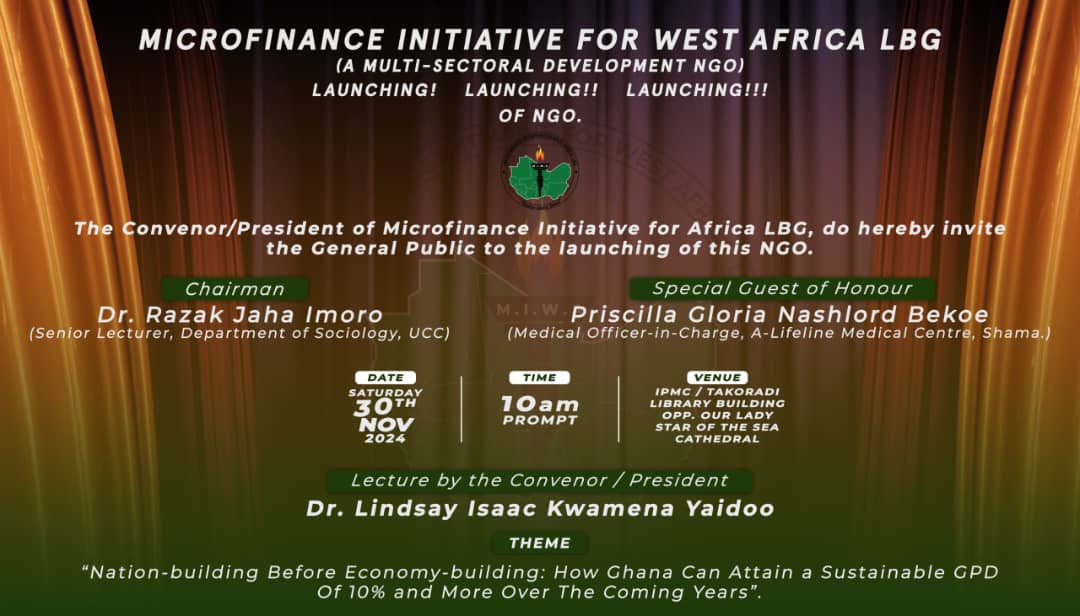
Lindsay Isaac Kwamena Yaidoo (Ph.D.) is the executive director of Microfinance Initiative for West Africa LBG (a multi-sectoral development NGO located in Sekondi-Takoradi, Ghana).

P.O. Box MC 884, Takoradi.

Email: microfinanceinitiativeforwa@gmail.com

The Art of Connection

At MIWA, we believe that true development comes from the power of connection. It’s not just about providing resources or offering assistance; it’s about building meaningful relationships that drive lasting change in communities. The most successful initiatives are those that connect people, ideas, and resources in ways that create sustainable impact.

Our approach is rooted in the idea that individual challenges are not isolated but deeply connected to larger societal issues. By addressing the root causes of poverty, inequality, and lack of opportunity, we can build a more equitable society. Our efforts in research, training, and community engagement focus on fostering connections that empower individuals, uplift communities, and ultimately contribute to a better future for all.

We recognize that true change is collaborative. It involves listening, learning, and working together with local communities to identify and implement the solutions that will have the most impact. MIWA’s programs are designed to create opportunities for people to come together and develop their own solutions, ensuring that everyone is an active participant in the process of growth and transformation.

In the end, the art of connection is about creating a network of hope, where individuals support one another and collectively strive for a brighter tomorrow. It is through these connections that we find our shared humanity and work towards achieving our mission of social justice and sustainable development across West Africa.

Beyond the Obstacle

In every community, obstacles stand between individuals and their dreams. Whether it’s limited access to education, economic hardship, or social injustice, these barriers can seem insurmountable. But at MIWA, we believe that no challenge is too great to overcome. Every obstacle is an opportunity to grow, learn, and innovate.

Our mission is to help individuals and communities break through these barriers, fostering a sense of hope and resilience. We understand that the path to progress is not always easy, but it is possible when we work together, united by a common purpose.

MIWA’s approach focuses on addressing the root causes of poverty and social exclusion. By providing the necessary tools, resources, and support, we empower individuals to take charge of their own futures. We believe in the strength of communities and the power of self-determination. Through our programs in research, training, and community engagement, we create sustainable solutions that allow people to rise above their challenges.

The true power of transformation lies in the ability to look beyond the obstacles and envision a brighter future. Every step forward, no matter how small, is a victory. Together, we can push past adversity and build a society where opportunities are accessible to all, and every individual can fulfill their potential.

Growth Unlocked

At MIWA, we believe that true growth is not just about expanding resources or increasing numbers; it’s about unlocking the potential within individuals and communities. Growth happens when people are given the opportunity to discover their own strengths, access the tools they need to succeed, and take ownership of their future.

Our mission goes beyond simply providing aid. We focus on creating pathways for self-sufficiency and empowerment. Through our programs, we equip individuals with the knowledge, skills, and resources to grow both personally and professionally. This isn’t about temporary relief; it’s about creating lasting, sustainable change that benefits entire communities.

By addressing the root causes of socio-economic challenges and focusing on capacity-building, MIWA helps unlock the potential in every person we serve. Whether through educational training, community development, or research, our approach ensures that individuals aren’t just surviving—they’re thriving.

Growth is unlocked when we collaborate, learn from one another, and share in the process of transformation. MIWA’s work is rooted in the belief that each person has the potential to contribute to their community, and by providing the right support, we can help them reach new heights. Together, we can create a future where opportunities are not limited by circumstances but defined by the drive to grow.

Collaboration Magic

At MIWA, we understand that true change is rarely the result of a single effort. The magic of collaboration lies in the power of diverse minds and voices coming together with a shared purpose. We believe that when people unite, bringing their unique strengths and perspectives, they can create something far more impactful than what could be achieved alone.

Collaboration is at the heart of everything we do. From our partnerships with local communities to our alliances with global organizations, we know that working together accelerates progress and creates lasting solutions. Our initiatives are not just about providing resources but about fostering a spirit of cooperation where everyone plays a vital role in achieving common goals.

By combining knowledge, resources, and experiences, MIWA’s collaborative approach allows us to address challenges more effectively and sustainably. Whether it’s in our educational programs, community engagement, or policy advocacy, we believe that working together helps us unlock innovative solutions that have a far-reaching impact.

Collaboration is more than a strategy for us—it’s a core value that drives everything we do. The magic happens when we join forces, and together, we can create a brighter, more equitable future for all. At MIWA, we invite you to be part of this collaboration, to bring your unique perspective, and to help us achieve the positive change we envision.

Teamwork Triumphs

At MIWA, we understand that no great achievement is made in isolation. The true triumph lies in the power of teamwork—where each individual brings their skills, knowledge, and passion to the table to create something greater than the sum of its parts. Our work in empowering communities across West Africa is a testament to the strength that comes from collaboration.

Teamwork is at the core of MIWA’s success. From our grassroots community initiatives to large-scale advocacy efforts, our achievements are a direct result of the dedication, expertise, and unified purpose of our team. We recognize that every challenge can be solved when we come together, combining our diverse strengths and experiences to drive progress.

Whether through collective problem-solving, sharing ideas, or providing support to one another, MIWA’s approach to teamwork fosters a collaborative spirit that ensures sustainable, impactful outcomes. Every team member—whether a staff member, volunteer, or community partner—plays a critical role in helping us achieve our goals.

Through teamwork, we unlock the full potential of individuals and communities. It’s not just about achieving results; it’s about how we work together to make those results meaningful and lasting. At MIWA, we celebrate the power of teamwork because we know that when we unite with purpose, there are no limits to what we can accomplish.

Adaptive Advantage

In a world that is constantly changing, the ability to adapt is not just an advantage—it’s essential. At MIWA, we understand that adaptability is key to overcoming the challenges faced by communities across West Africa. Whether it’s responding to shifting socio-economic conditions, technological advancements, or the evolving needs of those we serve, our success lies in our capacity to adjust and innovate.

Our approach is rooted in the belief that flexibility, learning, and continuous improvement are crucial for creating sustainable, long-term impact. We embrace change as an opportunity to grow and refine our programs, ensuring that they remain relevant and effective in addressing the ever-evolving needs of our communities.

MIWA’s adaptive advantage lies in our commitment to listening, learning, and responding quickly. We work closely with local communities, stakeholders, and partners to understand the challenges they face, and we use that knowledge to adjust our strategies and resources accordingly. By being agile, we are able to provide timely solutions that drive positive change.

In an ever-changing world, those who can adapt thrive. At MIWA, we believe that our ability to remain flexible and responsive is what allows us to continually improve and achieve our mission of empowering communities and fostering sustainable development. The future is always changing, and by embracing this, we can create lasting solutions that stand the test of time.